


Published April 21, 2026 · By SnapSite · 10 min read
How to Run a Winning Political Campaign: An Insider’s 2026 Playbook
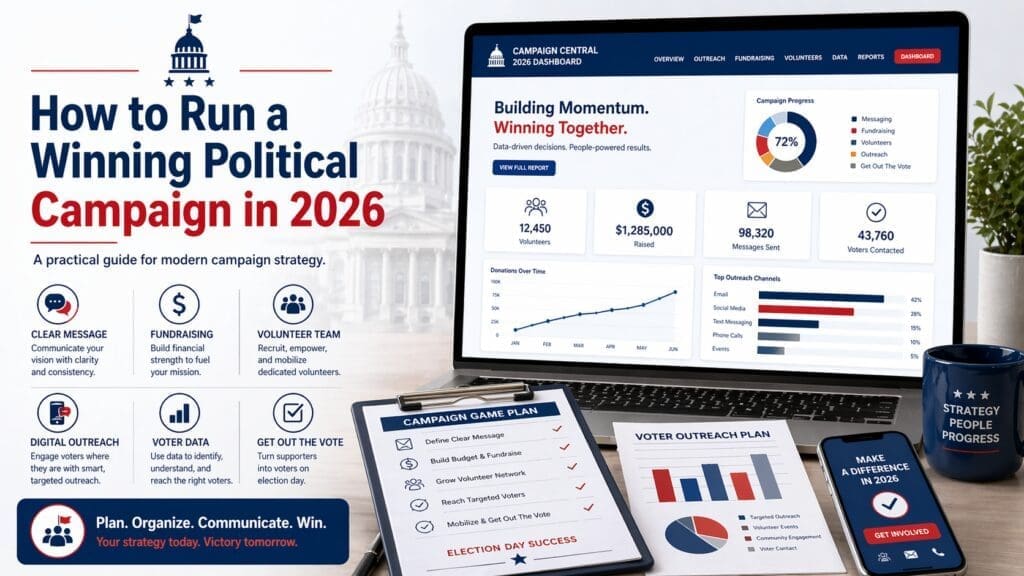
Running for office is equal parts exhilarating and exhausting — and the candidates who win are almost never the ones with the best ideas. They’re the ones with the best execution.
Whether you’re running for city council, county board, state legislature, school board, or a township trustee seat, the mechanics of winning look surprisingly similar. You need a clear message, a team that shows up, enough money to be heard, and a disciplined plan to move voters from “who’s that?” to “I voted for them.”
This guide is written from the other side of the ballot — by someone who has actually won elected office and served in county and city government. No fluff. Just the eight things that matter, in the order they matter, with the tools and tactics that work in 2026.
The 8 Steps to a Winning Campaign
- Lock down your message
- Build the team, then the plan
- Raise the money — all of it, early
- Know your voters before you talk to them
- Build a real campaign website
- Own your digital channels
- Master the room before the debate
- Win the last ten days
Step 1Lock Down Your Message Before You Print a Single Sign
Every winning campaign is built on three sentences a voter can remember. If you can’t explain why you’re running in the time it takes to walk from a mailbox to a front door, you’re going to lose votes you should have won.
Answer these three questions on paper before you do anything else:
- Why are you running? Not “because the incumbent is bad.” Because something specific needs to change and you’re the person to change it.
- What will you actually do? Voters are exhausted by candidates who promise everything. Pick two or three concrete priorities and own them.
- Why you? Your background, your service, your lived experience in the community — this is not bragging, it’s context. Voters need a reason to trust you with their vote.
Then compress the answers into a slogan. Not a jingle. A promise. “Safer streets. Smarter spending. Straight answers.” Done. Use it everywhere.
Step 2Build the Team, Then Build the Plan
Nobody wins alone. The candidates who run solo — answering every email, posting every flyer, driving every volunteer to every event — burn out by September and lose in November. Your first hire is your campaign manager. Everything else flows from there.
A realistic local campaign team in 2026:
- Campaign Manager — runs the day-to-day, owns the calendar, makes the calls you don’t have time to make.
- Treasurer — required by law in most states, and the single most boring job that will save your entire campaign from scandal.
- Communications Lead — handles press releases, letters to the editor, website copy, and the inevitable moment when something goes sideways.
- Field Director — owns the doors, the phones, and the volunteer sign-up sheet.
- Digital Lead — manages your website, social channels, email list, and online ads.
- Fundraising Chair — plans the events, tracks the donors, files the reports on time.
For a small local race, one trusted person can wear two or three of these hats. For a competitive state-level race, each is a full role, sometimes a full team.
Volunteers matter more than money. A hundred people willing to knock doors for you on a Saturday morning is worth more than $50,000 in mailers — and voters can tell the difference.
Step 3Raise the Money. All of It. Early.
The uncomfortable truth about campaigns: the candidate who raises more money wins about 85% of the time. Not because money buys votes, but because money buys reach — the mailers that remind voters you exist, the digital ads that show up during the six weeks people are actually paying attention, the yard signs in the right yards.
A 2026 fundraising plan should lean on four channels:
- Your personal network. The first $5,000 always comes from people who already know you. Do not skip the phone calls. Ask directly.
- Kickoff events. A single well-attended kickoff event with a clear ask can fund the first three months of a local campaign.
- Digital small-dollar donations. Platforms like ActBlue and WinRed make online giving frictionless. Every email, every social post, every yard sign should drive traffic to a donation page on your campaign website.
- PAC and endorsement funding. Once you’ve shown you’re a real candidate, aligned organizations will often contribute. Research who endorses candidates in your race and apply formally.
Build a spreadsheet with three columns: name, ask amount, next contact date. Work it every week.
Step 4Know Your Voters Before You Talk to Them
Winning campaigns are data operations disguised as community outreach. In every race, there are roughly three groups of people: voters who will definitely vote for you, voters who will definitely vote against you, and voters who are genuinely undecided. Your entire field strategy should ignore the first two groups and obsess over the third.
Most states sell or provide voter files that include names, addresses, party affiliation, and voting history (not who they voted for, but whether they voted). Modern campaign platforms — including purpose-built tools like SnapCampaign CRM — layer this data with walk lists, canvassing routes, call sheets, and sign-placement tracking so your volunteers spend their time on doors that actually matter.
The right question isn’t “how many doors did we knock?” It’s “how many persuadable doors did we knock?”
Step 5You Need a Website. A Real One.
A candidate without a modern website in 2026 looks unserious. Voters Google you within thirty seconds of hearing your name — and if the first result is a half-finished Facebook page from 2019, you’ve already lost that voter.
Your campaign website needs five things:
- A clear biography with a real photo (not a selfie).
- A short issues page that matches the two or three priorities you locked in during Step 1.
- An events page so supporters know where to find you.
- A donation page that works on a phone in under fifteen seconds.
- A volunteer sign-up form that captures email and phone.
If you try to build this yourself the week before filing, it will look like it. A better path is to start with a purpose-built campaign website platform that handles the messaging, donation integration, volunteer signup, and ADA accessibility out of the box. SnapSite’s Campaign Website Builder was built specifically for this — candidates can launch a professional, mobile-friendly campaign site in days, not weeks, with donation forms and volunteer signups wired in from day one.
Step 6Own Your Digital Channels — But Don’t Live on Them
Social media wins and loses races, but probably not the way you think. You are not going to tweet your way to victory. What social media actually does:
- Reaches voters who will never answer the door. Renters, young professionals, and busy parents consume politics on their phones.
- Validates you to undecided voters. When a voter Googles you, your recent Facebook activity is a character reference.
- Energizes your base. Supporters who see you online become supporters who show up offline.
The 2026 rules of campaign social media:
- Post consistently, not constantly. Three to five posts per week is plenty. Ten per day is noise.
- Video beats text every time. A thirty-second phone video of you explaining one issue will outperform five written posts.
- Respond to comments in the first hour. The algorithm rewards early engagement, and voters notice candidates who actually reply.
- Run targeted ads in the last six weeks. A modest $500–$2,000 geo-targeted ad buy in your district is one of the most cost-effective things a local campaign can spend money on.
Build an email list from day one. Social platforms come and go. Your email list belongs to you.
Step 7Master the Room Before You Master the Debate
You will speak at candidate forums, chamber events, VFW halls, church breakfasts, and neighborhood association meetings. You will shake hands at parades, farmers’ markets, and Friday night football games. Every one of those moments is a performance, and the candidates who practice win.
Three things to drill before the campaign starts:
- Your two-minute introduction. Word-perfect. You will give it a hundred times.
- Your answer to the three hardest questions in your race. The ones you wish nobody would ask. Practice them until the answer is calm and confident.
- Your close. Every speech ends with an ask — for a vote, for a volunteer, for a donation. Never finish without one.
Debates specifically reward preparation, not cleverness. Know your opponent’s record better than they do. Know your own record cold. Stay on your priorities. Don’t take the bait. The candidate who keeps their composure almost always wins the post-debate coverage.
Step 8Win the Last Ten Days
Campaigns are won and lost in the final stretch. Everything before October is positioning. Everything in the last ten days is execution.
A disciplined Get Out the Vote (GOTV) plan in 2026 includes:
- Early vote targeting. In most states, a significant share of the electorate now votes before Election Day. Identify your supporters and push them to vote early so you can focus Election Day resources on turnout, not persuasion.
- Door-to-door reminders. In the final weekend, your volunteers should be knocking the doors of your supporters — not trying to persuade new voters. Remind, don’t convince.
- Ride-to-the-polls logistics. Seniors, voters without vehicles, and shift workers often need help. A coordinated ride operation can net dozens of votes in a close race.
- Social proof content. Supporters posting “I just voted for [candidate]” on Election Day is the most persuasive content you can generate. Encourage it.
- Clean Election Day war room. Staff monitoring polling locations. A hotline for voter issues. A real-time turnout dashboard. Rapid response to anything unexpected.
And then — win or lose — you call your opponent, you thank your volunteers, and you show up the next morning to start the work.
The Tools That Actually Help You Win
The mechanics of a campaign haven’t changed much in fifty years. What has changed is the toolset. The candidates winning competitive local and state races in 2026 are running on integrated platforms that handle:
- Campaign website with donation and volunteer capture — ADA-compliant, mobile-fast, and tied into a real CRM
- Voter file + walk list management — so canvassers spend time on persuadable doors, not random ones
- Yard sign placement tracking — who agreed to a sign, who has one up, who needs a replacement
- Email and SMS outreach — with compliance built in
- Volunteer coordination — shift scheduling, check-in, follow-up
- Fundraising and FEC / state reporting — with the treasurer’s job mostly automated
This is exactly what SnapSite’s Campaign Website Builder and SnapCampaign CRM were built for. They were designed by a former elected official who understands the difference between tools that look good in a demo and tools that survive the last weekend of a close race.
Launch Your Campaign at snapsite.us →
Frequently Asked Questions
How much money do I need to run for local office? Local campaign budgets vary widely by district size and competitiveness. A typical city council race runs $5,000–$25,000. County-wide races often require $25,000–$100,000 or more. The first $5,000 almost always comes from the candidate’s personal network. Better-funded candidates win roughly 85% of races — not because money buys votes, but because money buys reach. Do I really need a campaign website? Yes. Voters Google you within seconds of hearing your name. A professional, mobile-friendly campaign website with a clear biography, issues page, donation form, and volunteer signup is the minimum expectation in 2026. Without one, voters assume you are not serious. What is the most important part of a political campaign? Message discipline and voter contact. A clear, simple reason you are running, explained consistently, combined with a disciplined field operation that reaches the right voters at the right time. Every winning campaign shares these two traits regardless of size. How early should I start my campaign? For a local race, 6–12 months before the election. For state or federal races, 12–24 months. The earliest work is internal — message, team, and initial fundraising — not public campaigning. What is a GOTV strategy? “Get Out the Vote.” It is the disciplined push in the final ten days of a campaign to turn identified supporters into actual voters. It includes early-vote targeting, door-to-door reminders, ride-to-the-polls logistics, and Election Day turnout operations. Many close races are won or lost in GOTV. How do I track yard signs, volunteers, and donors without losing my mind? Use a campaign CRM built for this specific job. Generic spreadsheets break down by month three of a real race. Purpose-built tools like SnapCampaign handle voter lists, walk sheets, sign tracking, volunteer coordination, and donor records in one place.
The Road to Victory
Winning an election isn’t about having the most money, the loudest voice, or the flashiest signs. It’s about earning trust, one conversation at a time, and making sure every conversation adds up to a vote on the first Tuesday in November.
If you run a disciplined campaign — clear message, strong team, honest money, smart data, modern digital, prepared speaking, and a relentless final ten days — you give yourself a real shot. The rest is showing up.
Thinking about running? Start with the foundation: a professional campaign website and a CRM that won’t collapse the week of the filing deadline. See what’s possible at snapsite.us.


